In this article
Classify each expense by who paid, what the purchase was for and who ultimately owes the cost before trusting the report total.
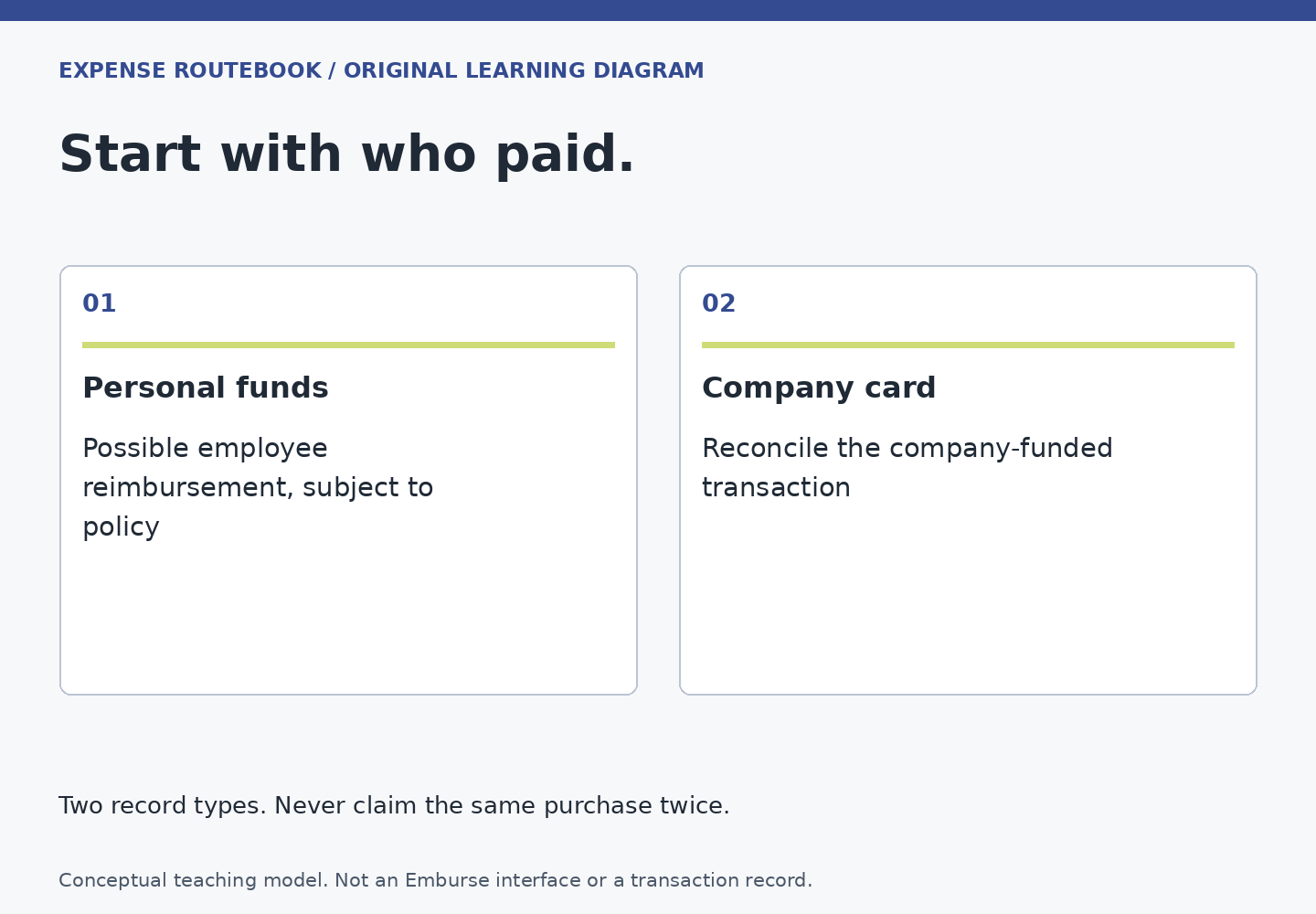
“Personal card” and “personal expense” sound similar but answer different questions. A personal card can pay for an eligible work purchase. A corporate card can accidentally pay for a non-work purchase. Before choosing a category or expecting a reimbursement, separate the payment instrument, the purpose of the purchase and the financial treatment your employer requires.
Answer three questions for every line
- Who funded the purchase? Was it paid personally, through a company card, by the employer directly, or by another approved method?
- What was it for? Identify the genuine business activity and any personal portion.
- What treatment is required? Determine whether an employee payment, company-card reconciliation, client allocation or another authorized adjustment is needed.
Do not let the answer to one question substitute for the others. Paying personally does not establish that the employer will reimburse the purchase. A business purpose does not establish that the employee should receive money if the company already paid the merchant. Approval and policy still matter.
Reimbursable and billable are different dimensions
Professional’s classification guide distinguishes employee reimbursement from billing a third party. It describes company-card expenses as non-reimbursable to the employee and eligible out-of-pocket expenses as reimbursable. It also explains that defaults can be configured. Follow your employer’s setup rather than assuming every field is editable or every default is correct for every line.
A company-paid hotel might be allocated to a client while creating no reimbursement to the traveler. An employee-paid internal training supply might be reimbursable without being billed to a client. Neither example says that client billing or reimbursement is authorized; it shows why the two questions should be resolved separately.
A fictional mixed-payment report
Amir has a company-card train charge of 72, an approved employee-paid taxi charge of 28 and an employee-paid adapter costing 20, all in the same fictional currency. The report documents 120 of spend. If all three lines are eligible and no other adjustments apply, the employee-paid portion is 48. The presence of 120 at the top of the report is not evidence that a 120 bank deposit is due.
Now suppose the adapter was a personal purchase. Amir cannot make it a business expense by marking the card as personal or writing “reimbursement” in the purpose field. He asks the policy owner how that purchase should be excluded or recorded and checks the revised total. Our reimbursement route map shows how to carry the correct amount into payment tracking.
When a corporate-card charge contains a personal portion
Do not remove a real company-card transaction merely because part of it should not be borne by the employer. Preserve the transaction and follow the authorized personal-expense or split process. Professional’s personal-expense guide describes full and partial handling and notes that category names can vary. Its treatment can affect reimbursement totals, so ask finance how the company expects the balance to be resolved.
A fictional hotel folio might include a legitimate work stay and a personal add-on. The useful record identifies both portions and preserves the total charged. Do not assume that making a category selection automatically completes any repayment obligation. Obtain the employer’s instructions rather than sending money or creating an offset yourself.
Check imported data before adding a manual line
A receipt may arrive before the matching card feed. If you create a separate out-of-pocket claim and later add the card transaction, the same purchase can appear twice. Compare merchant, amount, currency and the relevant dates before deciding they represent separate events. Use the duplicate review process for the product-specific correction path.
For Professional, the report definitions distinguish non-reimbursable, reimbursable and personal-expense data. An unfamiliar total deserves a line-by-line explanation, not a guess based on the card’s logo.
Finish with a classification check
For each purchase, you should be able to state who paid, what work it supported, which portion is eligible and what employee payment, if any, is expected. Use a clear business-purpose note for the work connection. Keep any policy question visible until the responsible team answers it. A complete expense record can serve reconciliation and reporting even when it produces no reimbursement at all.